
1. Connected and fully separated circuits
The distinction between connected and fully separated circuits is determined by the technical construction and the possibility that refrigerant can move between the circuits.
Connected circuits
Circuits are considered one cooling system when refrigerant can move between the different circuits. This also applies when the connection is only possible via a valve, bypass, or other diversion that remains closed during normal operation. With connected circuits, the nominal charge of the different circuits is added together. The installation is monitored as one cooling system for, among other things, leakage calculations and periodic checks.
Fully separated circuits
Circuits are considered separate cooling systems when they are demonstrably completely separated from each other and refrigerant cannot move between the circuits in any way. Each circuit then has its own nominal charge and is assessed separately for leakage and periodic leak tightness checks.
2. Registering circuits in Climapulse
The way circuits are registered in Climapulse depends on the refrigeration construction of the installation.
Connected circuits: one installation
When the circuits together form one cooling system, you register them within one installation as connected circuits. Climapulse adds the nominal charges of the circuits together. The leakage calculation, forecasts, and refrigeration monitoring take place at the installation level.
Fully separated circuits: two registration methods
When the circuits are fully separated, they must be monitored as separate cooling systems. In Climapulse, you can choose between two registration methods for this:
Method 1: Register each circuit as a separate installation
For every fully separated circuit, you create a separate installation in Climapulse. As a result, each circuit is managed as an independent installation, with its own nominal charge, leakage calculation, forecasts, appointments, and registered actions. This registration method directly follows the classification from the regulations, where each fully separated circuit is considered a separate cooling system. When one physical machine consists of two separated circuits, two installations are therefore registered for this in Climapulse.Method 2: Register fully separated circuits within one installation
You can also register the different circuits under one installation and configure them to be treated as fully separated. The parent installation is retained as one physical machine, while the underlying circuits are each monitored separately. Each circuit thereby receives its own:- Nominal charge
- Leakage calculation
- Forecasts and action plans
- Periodic refrigeration monitoring
- Appointments and actions
- Reports
The setting 'Treat as fully separated' ensures that Climapulse processes the circuits separately and not as one combined cooling system.
Both registration methods support the separate monitoring of fully separated cooling systems. The choice depends on how you want to administratively manage the physical installation. In both cases, the circuits must be demonstrably fully separated, and the registration must make it clear which actions and checks relate to which system.
3. Registering circuits within one installation
To treat multiple circuits within one installation as fully separated, follow the steps below.
- Open the relevant installation in Climapulse Service.
- Go to the installation details and find the Circuits section.
- Check the registered circuits and their nominal charges.
- Click on 'Treat as fully separated'.
Please note:
- Adding multiple circuits to an installation does not automatically mean they are treated as fully separated. Always check which circuit configuration is active.
- Editing an existing configuration can only be done by a user with the administrator role.
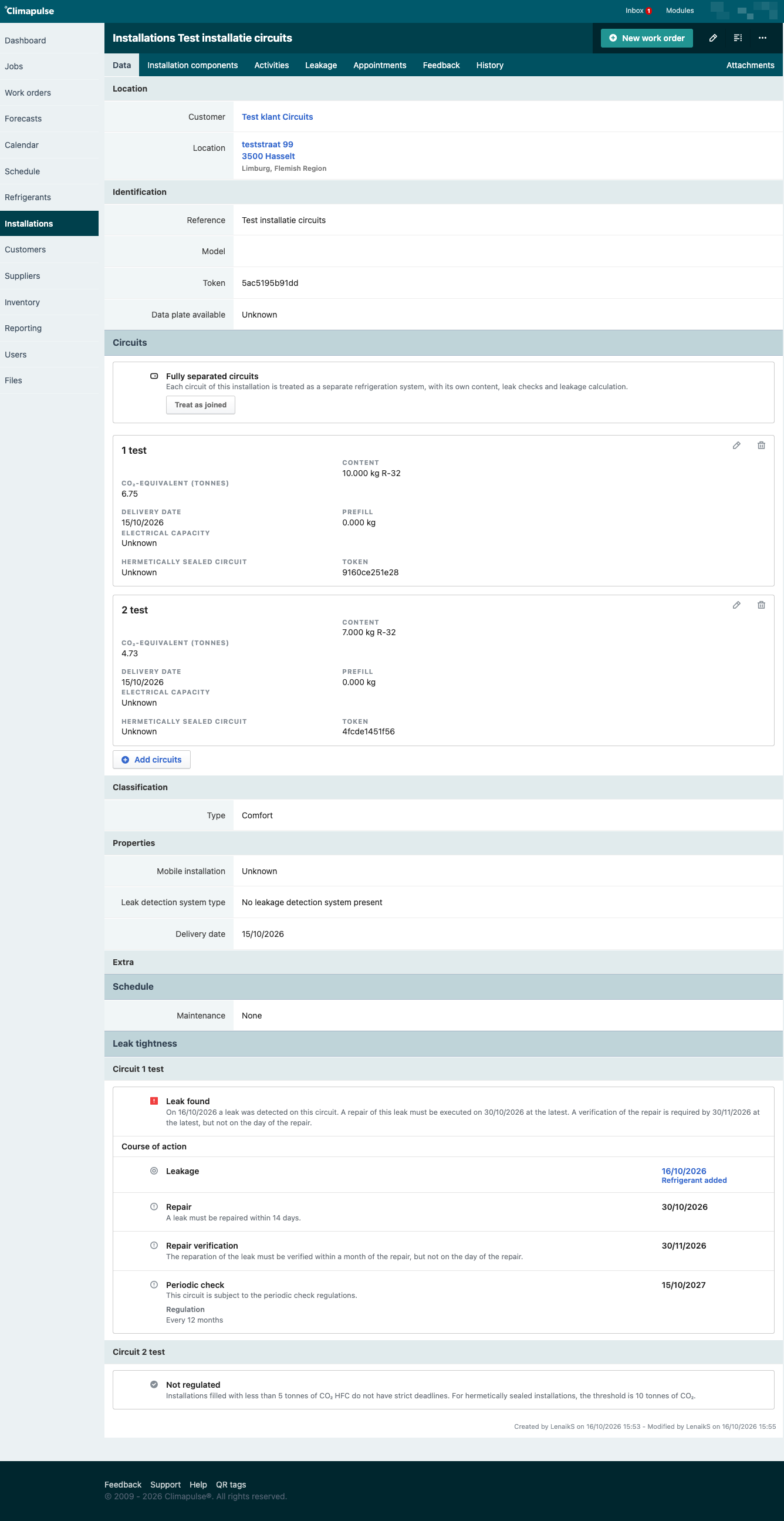
When you choose to treat circuits separately, the ‘Charge’ section is replaced by an overview of the separate circuits. The nominal charge is then tracked per circuit and no longer at the level of the entire installation.
In the Leak tightness section, a separate action plan appears for each circuit. This is determined based on the configured forecasts and performed actions.
4. Monitoring of fully separated circuits within one installation
When circuits are treated as fully separated, the refrigeration monitoring takes place at the circuit level.
Installation overview
Detail
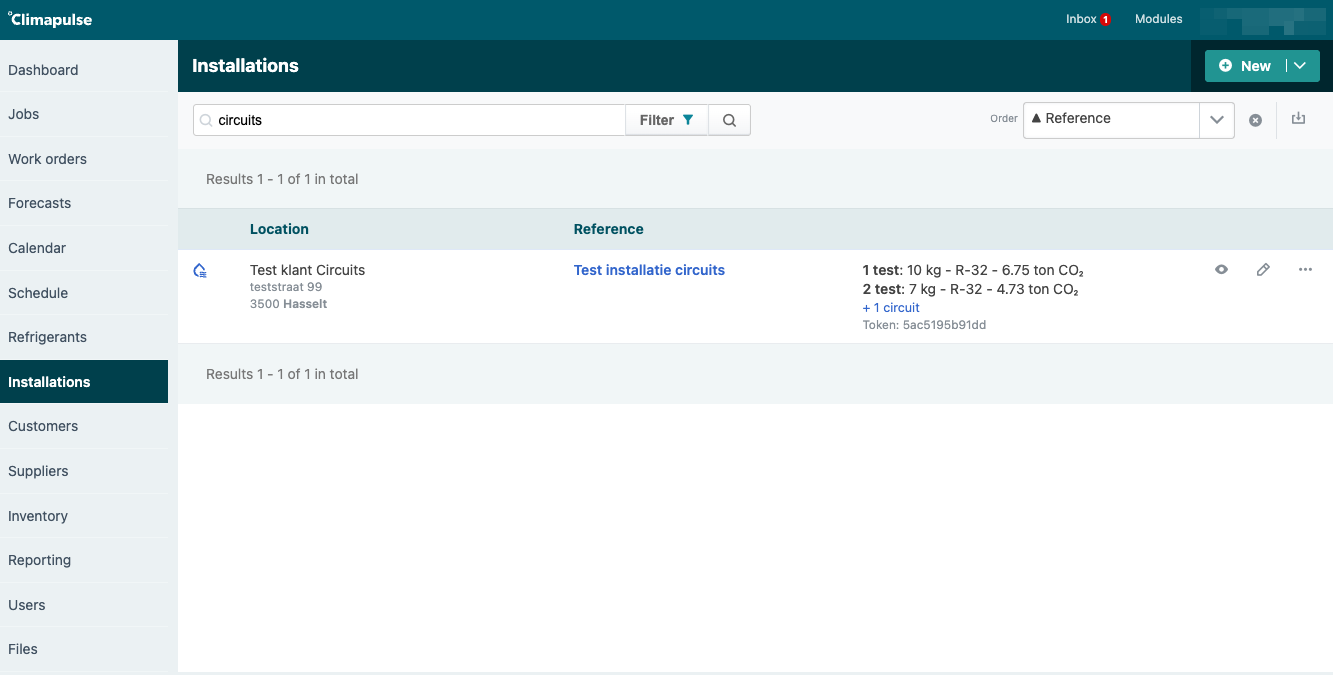
On the overview of installations, if the installation is made up of separate circuits, we now show the circuits with their nominal charge and refrigerant in the right column. We show the first two circuits here; if there are more, we show a link to expand this information further.
Work orders and actions
Add refrigerant and recover refrigerant
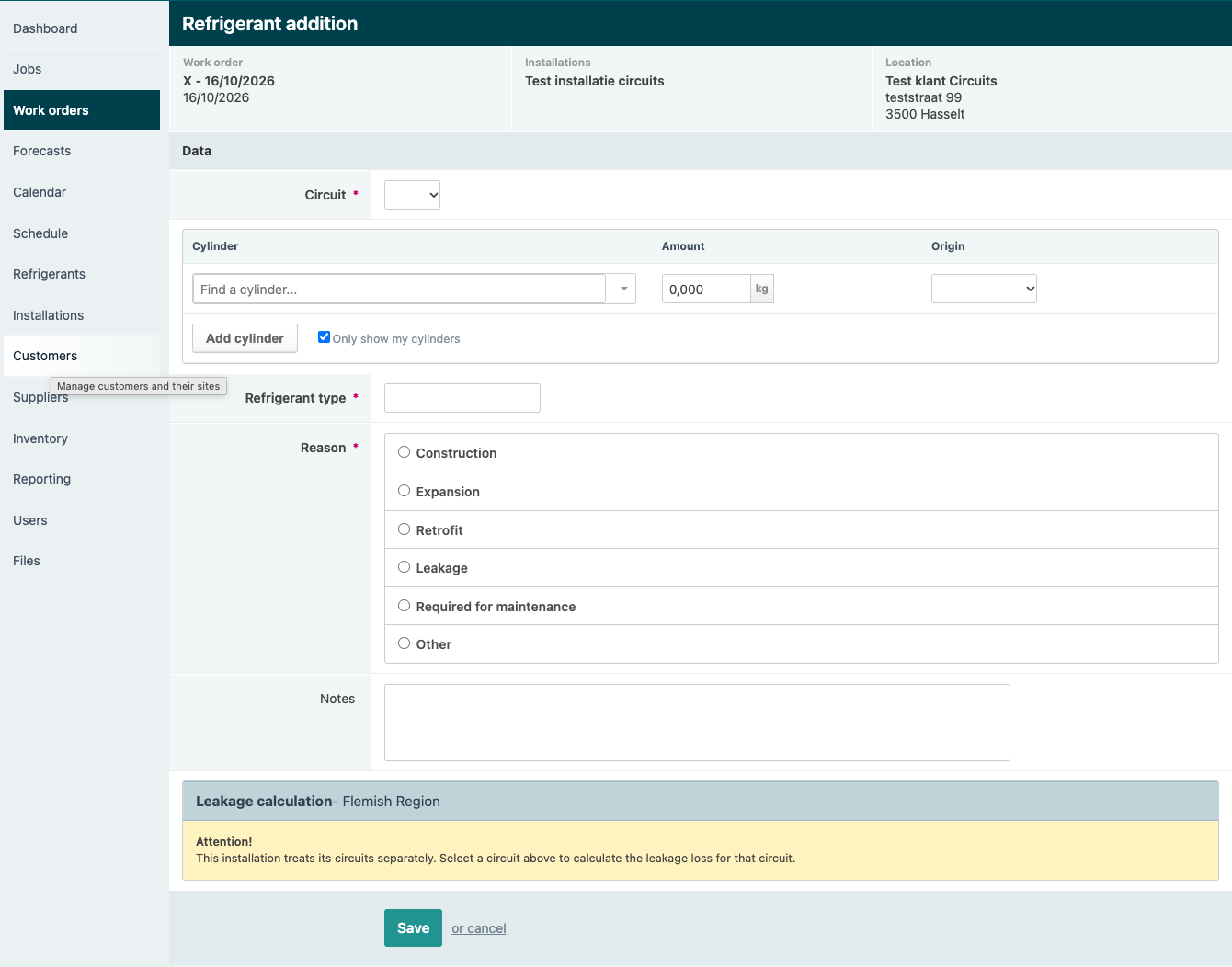
If an installation consists of separate circuits, it is mandatory to specify a circuit for both actions. Since circuits are treated separately, they will each get their own leakage calculation. Adding refrigerant therefore happens explicitly on a circuit, no longer on an installation. The message at the bottom of the action also makes the mandatory circuit selection clear to the user.
Leak check, pressure test, and evacuation
For these three tests as well, in the case of a separate circuit, the circuit selection is necessary.
Maintenance, repair, and audit
For all other actions, the circuit selection has been added and is always optional. Maintenance or repair, for example, can happen on a circuit or on the entire shell (the installation).
5. History when editing the circuit configuration
When switching between connected and fully separated circuits within one installation, existing historical registrations are retained.
The data is processed according to the circuit configuration that applied at the time the action was registered.
6. Switching back to connected circuits
An installation with fully separated circuits can be set up again as an installation with connected circuits. During this switch:
- The nominal charges of the circuits are treated together again for the calculations at the installation level.
- The forecasts are recalculated.
- The existing historical registrations are retained.
The circuit configuration must always match the actual refrigeration construction of the installation.